Samar - Why do we choose to live together?
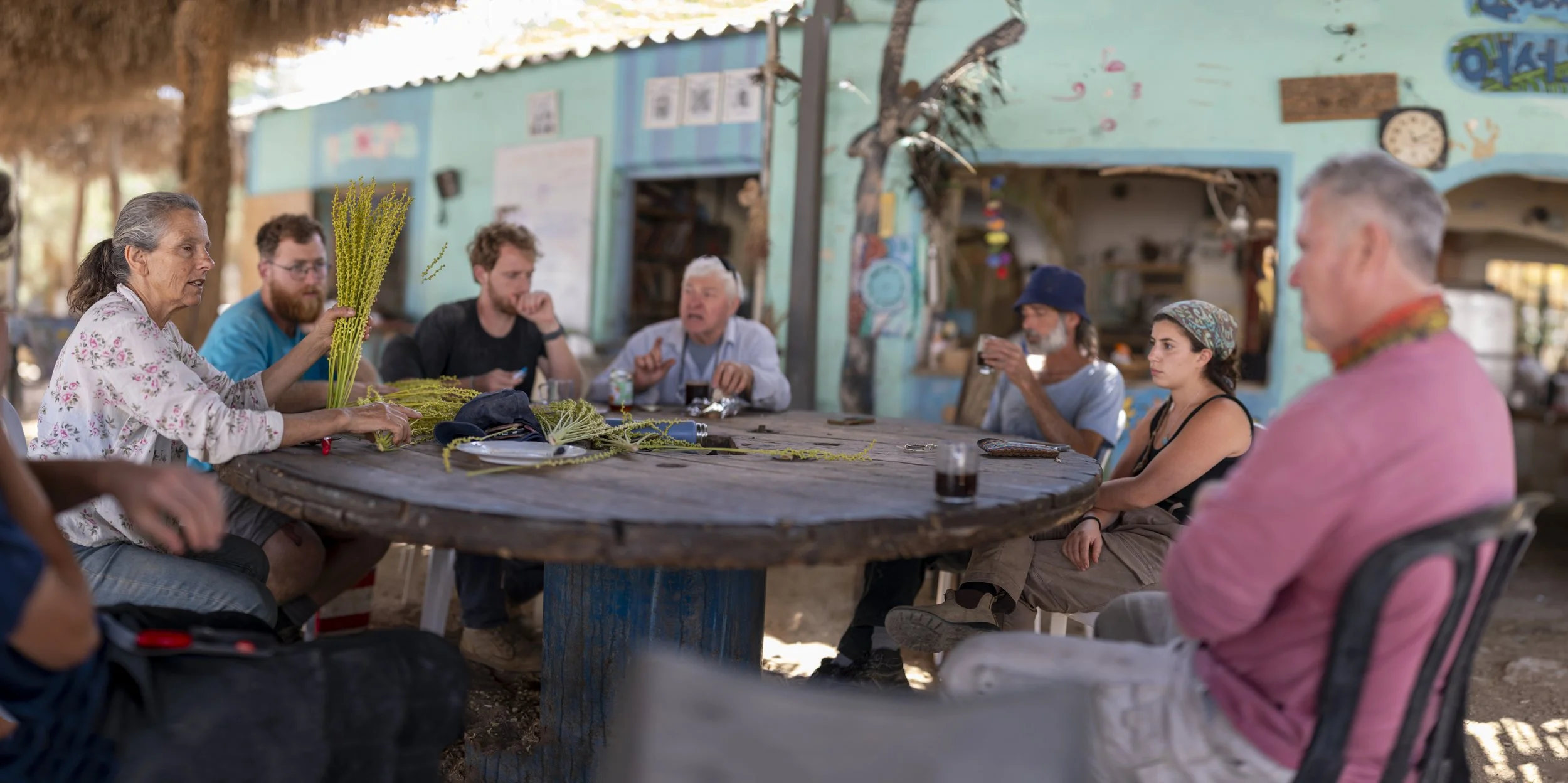
Samar is a unique kibbutz that evolved naturally and was shaped by the people who chose to live there. It grew from the needs and values of its members, built through action, collaboration, and a shared sense of belonging. The community thrives on open hearts, hands-on contributions, and a willingness to listen and work together.
At the heart of Samar is its "junkyard," a space where discarded items accumulate with purpose. This unstructured space symbolizes the kibbutz itself: raw, unpolished, and full of life. Here, things take their place in the flow of daily life. This space speaks a language of its own, where creativity, functionality, and community collide.
Samar faces its challenges as it grows and adapts. The absence of formal systems often leaves room for tension and uncertainty. Balancing personal freedom with the needs of the community requires constant negotiation and a deep trust between members. The kibbutz continues to evolve through these challenges, shaping itself in ways that reflect the resilience and creativity of the people who call it home.

" A community needs something that connects people on a deeper level. If the ideology is temporary, the community will be temporary. If there is an eternal value holding people together—like love—then it can last."
-
Question:
What are the lessons you have learned from living in Kibbutz Samar? What makes a community succeed, and what keeps you staying in this experiment?Uriel:
I think you have to divide this into two parts. A kibbutz is first and foremost a community with economic partnership, and that is something that barely exists in the world. This kind of partnership forces you to be connected to people in an uncompromising way.There was an ideology behind it. It all started with socialism in the 1920s, which itself began with Marx and Engels. The people who founded the kibbutzim came from Europe, full of belief, with fire in their eyes. They brought a vision that merged with the national need to establish and settle the country. There was a fusion of a practical idea and a strong vision, and that is what fueled this movement.
At the beginning, there was self-discipline, and the leaders had legitimacy to impose discipline. But once the state was already established, once the mission of settling the land was completed, the economic partnership lost its meaning. Why continue to be financially connected if there is no longer an external threat? The imposed equality in the kibbutzim was artificial. People are not equal in their needs, so giving everyone the exact same thing simply did not work.
Question:
How did Kibbutz Samar choose to do things differently?
Uriel:
In Samar, they decided to cancel forced equality but maintain the partnership. The question was how to create a kibbutz where people would enjoy living, where everyone could choose what they wanted to do, but with a sense of responsibility. Freedom must come with responsibility.In the old kibbutzim, discipline was mandatory. Without it, the system would not have worked. In Russia and all the communist states, a dictatorship was necessary because once you take away personal incentives, you have to enforce order. And once the fear of external enemies disappeared, there was no motivation to maintain the system.
So we had to change our mindset. Instead of rewarding people with money, the kibbutz created a culture where the more someone worked, the more respect they earned. The "religion of labor" became central, but even that did not last. People do not work just for respect; they need to feel they have economic security.
Question:
How has your perspective on community changed over the years?
Uriel:
When I came here as a young man, I was looking for a place with true mutual responsibility. It captivated me. I saw it as something spiritual, a form of Tikkun Olam (repairing the world). A society where people care about the greater good, not just themselves.It was also a great adventure, like being a cowboy settling the last frontier of the country. There was nothing here, and there was this feeling of excitement, of a shared vision. I wanted to raise a family in a place where children could roam freely in nature, surrounded by people who cared for them as if they were their own uncles.
But over the years, as life in the community continued, I saw things differently. At first, there is idealization, like a honeymoon. After ten or fifteen years, problems start accumulating. People get frustrated, they get hurt by each other. Some stop coming to communal meals, some avoid social gatherings. If there is no deeper foundation holding the community together, then when a crisis comes, there is nothing to lift you back up.
Question:
What does a community need to sustain itself in the long run?
Uriel:
A community needs something that connects people on a deeper level. If the ideology is temporary, the community will be temporary. If there is an eternal value holding people together—like love—then it can last.When a crisis happens, when things get tough, you need something to lift you up. If there is nothing deeper binding you to the people around you, then what stops you from leaving? Living in a community is not easy. It requires giving up some privacy, giving up personal ownership. For example, your house is not really yours, you live knowing that you do not own things the way people do outside of the kibbutz.
It requires patience and the understanding that community life comes with challenges, not just benefits.
There was a study on intentional communities over the past 200 years, and they found that only 2% of them survive long-term. And what do all the successful ones have in common?
Faith in a higher power.
The only communities that truly lasted were religious communities, like the Amish. A community needs something greater than the individual to hold it together.
Question:
What is your role in the transformation that the kibbutz is undergoing today?
Uriel:
I feel that my role now is to dismantle the existing structure and build something new. Privatization is part of this process. I realized that a community cannot survive without adapting to today’s economic realities.When the financial crisis hit, we understood that it was not just about money—it was about trust. No one could take on leadership roles because no one trusted them, and everything just kept deteriorating until it reached a breaking point.
So I jumped at the opportunity. I said, "Guys, we are dismantling the current system and building something new that fits today’s world."
Now I see how kibbutzim that have undergone change are thriving. People are buying houses, moving in because they want both community and security. But a community does not have to be an extreme economic partnership. It can be a supportive space where people feel connected but without the burdens that destroyed so many kibbutzim.
We need to stay true to ourselves, to be authentic. The idea that "everyone must be the same" no longer works. People need to maintain their individuality while also knowing how to live together, to respect each other, and to create a space of mutual trust.
The future of communities is not in returning to the past, but in deeply understanding how people can truly cooperate over time.
“People talk about community as if it is something that exists on its own, as if once you build the structure, the spirit will just appear. But community is a practice. A daily effort. You wake up and you choose to be part of it. You offer something of yourself, and sometimes it is received, sometimes it isn’t. But you offer it anyway.”
-
"We are in a place where we have space, and the space is physical. Our kibbutz is a kibbutz with few people and a large area, and the result is that there is room for things. So anyone who wants can do something in the area, there is a lot of space, and this creates a certain peace, a certain freedom. I think one of the things that make Samar special is that there is space here, and the space is also physical. Our kibbutz is small, but there is a large area, and that’s what creates room for things. It’s quiet and free."
The physicality of the space in Samar is what allows for freedom, according to Yaniv. It’s a space that invites creativity, spontaneity, and the ability to make something from nothing. The size of the land means there is room for people to express themselves, try out ideas, and live in a way that’s personal and collective at once. Yaniv emphasizes the freedom this space offers: "The space is raw, unpolished, and full of life."
"But it’s also hard," Yaniv continues. "The community faces challenges. The absence of formal systems often leaves room for tension and uncertainty. Balancing personal freedom with the needs of the community requires constant negotiation and a deep trust between members. We had to learn how to live together, to manage the tension that comes with closeness and freedom. There were moments when things didn’t work, but that’s part of the process."
Samar is not without its difficulties. The freedom it offers can also create friction. The absence of clear structures can lead to moments of discomfort, and the challenges of living in such close quarters require a constant reworking of boundaries and expectations. But for Yaniv, this is what makes the community work. "We learned to coexist in a space where everything wasn’t always perfect. It’s a place of participation and shared responsibility. Everyone contributes in their way. That’s the spirit of the community here."
Yaniv speaks about the shared responsibility in the kibbutz, where each person’s contribution matters, whether it's tangible work or emotional support. "I think that when people are in such a space, they can create freely, and that brings the community to life. It’s a freedom that allows for spontaneity and creativity. The community here is built through these acts of doing."
Yet, despite all the freedom and collaboration, the challenges are real. The lack of formal systems in the community means that the responsibility to maintain harmony falls on the members themselves. "We had no formal procedures or structures, so sometimes it was hard to keep everything in balance," Yaniv reflects. "But over time, we learned how to navigate that. The community is constantly evolving, and we have to adjust and adapt."
Yaniv sees Samar as a place where everyone brings their own energy. Each person’s contribution adds to the fabric of the community, and together, they shape a space that is both functional and creative. "There’s no art committee, no procedure. Everything happens organically – someone builds, someone else creates. It’s all part of what makes the place alive."
Ultimately, Yaniv views the community of Samar as a living, breathing entity—constantly shifting, growing, and transforming. Despite its challenges, the community is united by a shared sense of responsibility and a willingness to work together. "Everyone contributes in their way. That’s the spirit of the community here," he says. "What we have built here isn’t perfect, but it’s real. And that’s what matters."
"You don’t need a lot of money or a perfect plan. You need the willingness to show up every day and put your hands in the soil. It’s about being present, not perfect."
-
text coming soon
-
text coming soon
"Everything I get angry at or oppose here is because it's no longer as free as I would like it to be. But every such freedom also comes with a price. And sometimes I'm not willing to pay it."
-
text coming soon